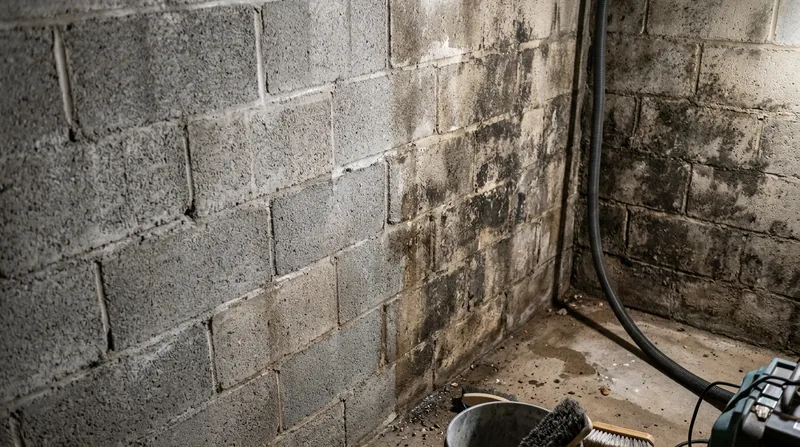




Reading's 1900s brick rowhouses in the West End and Centre Park, the block ranches of Shillington, and the stone farmhouses out toward Mohnton all share one thing: below-grade walls that stay damp for months. When clay-rich soil over shale and limestone holds water against a foundation, and the Schuylkill valley water table climbs after every heavy rain, moisture finds the coldest surface in the basement and mold follows. Basement Mold Remediation in Reading starts with finding where the water is coming from, not with a spray bottle. We treat the affected surfaces, contain the work area, and fix the drainage or humidity problem that let mold grow in the first place. If you have smelled that musty odor in a Pennside cellar or watched efflorescence bloom on a Wyomissing block wall, the moisture has been there a while. Start with a free basement inspection so we can trace the source before anyone touches a surface.
Why Basement Mold Remediation Matters in Reading's Older Housing Stock
Most of Reading's housing was built before basement waterproofing was standard practice. Stone rubble walls in Centre Park rowhouses, early block in Shillington split-levels, and shallow cellars in the older twins along Penn Street all wick groundwater through mortar joints and porous masonry. Add the freeze-thaw cycle that opens old mortar every winter, and you get chronic seepage rather than a one-time leak. Mold growth needs only dampness and organic material, and old plaster, wood framing, and cardboard storage in a basement provide both.
- Stone and brick foundations in 1900s rowhouses pull groundwater through the wall itself, not just through visible cracks.
- Block basements in 1950s-1970s Wyomissing and Sinking Spring homes often show efflorescence and mold along the bottom course where the footing drain has silted shut.
- Valley-bottom homes near the Schuylkill and the creeks sit over a high water table that rises fast after spring melt and heavy storms.
- Older rowhouses with shallow cellars trap humid air with little ventilation, so condensation feeds mold even without a visible leak.
In every one of these cases, treating the mold without correcting the moisture source means it returns with the next wet season.
Key info: A homeowner in the 19602 zip code called us after scrubbing a mold patch on a block wall three times in two years. The wall was dry to the touch but the base of the block read damp with a moisture meter, and the sump basin was dry because the footing drain had collapsed. The mold kept returning because the wall never dried out.
For official guidance on moisture and mold in buildings, the U.S. Environmental Protection Agency publishes a mold guide for homeowners that covers moisture control and cleanup principles.
How We Run Basement Mold Remediation in Reading from Diagnosis to Clearance
Mold remediation without a moisture diagnosis is guesswork. We start by finding why the basement is wet, then we remove the mold growth, then we correct the source. On a stone-walled cellar in Pennside, that might mean repointing mortar and installing an interior perimeter drain. On a poured-wall basement in a newer Muhlenberg Township subdivision, it might mean sealing a cold joint and adding a dehumidifier set to a fixed humidity target. The sequence matters because remediation done before the water is controlled will not hold.
- We walk the basement with a moisture meter and a hygrometer to map damp zones, check efflorescence, and locate the musty smell source.
- We set up containment with plastic sheeting and negative air pressure so spores do not spread to the living space above.
- We remove mold-damaged porous materials (drywall, insulation, cardboard) and bag them for disposal.
- We treat affected framing and masonry with an antimicrobial and HEPA-vacuum the work area.
- We correct the moisture source with drainage, crack injection, wall sealing, or humidity control, depending on what the diagnosis shows.
- We verify clearance with moisture readings and a visual inspection before we take down containment.
Only after the moisture source is corrected do we consider the job finished.
Key info: A Sinking Spring ranch had mold across the lower two feet of a block wall and a musty smell that reached the first floor. The cause was a downspout discharging within a foot of the foundation, sending roof water into clay soil that could not absorb it. We extended the discharge line, sealed the wall, and remediated the growth. No interior drain was needed in that case.
When the diagnosis points to chronic hydrostatic pressure rather than a single defect, an interior drain tile system is often the more practical fix than excavating the exterior.
Remediation and Moisture-Control Approaches We Use in Reading Basements
The right approach depends on how the water is getting in and what materials are affected. Here is how the common methods compare for Reading's housing stock.
| Approach | Description | Best for |
|---|---|---|
| Containment and surface treatment | Seal the work area, remove damaged porous materials, HEPA-vacuum, and treat framing and masonry with an antimicrobial. | Localized mold growth on framing or wall surfaces where the moisture source is already identified. |
| Crack injection and wall sealing | Epoxy or polyurethane injection for poured-wall cracks, plus parging or sealing on block and stone walls to cut seepage. | Poured basements in newer subdivisions and block walls with visible seepage at cracks or the footing joint. |
| Interior perimeter drain and sump | Cut a channel at the footing, install drain tile to a sump basin, and pump discharge away from the foundation. | Chronic hydrostatic pressure and high water table conditions in valley-bottom homes. |
| Vapor barrier and dehumidification | Install a vapor barrier on walls and set a dehumidifier to a fixed humidity target to keep surfaces dry. | Humid shallow cellars and basements where condensation, not liquid water, drives mold growth. |
We recommend the least invasive method that solves the actual problem, and we say so when simple crack sealing is enough.
Basement Mold Remediation Cost in Reading: What to Expect
Pricing for basement mold remediation in Reading starts from $1,500 for a contained, single-area job with surface treatment and a clear moisture source. Most full-basement remediations in older rowhouses and stone-walled cellars run higher because of the square footage, the porous materials that must be removed, and the drainage correction that follows. The remediation itself is usually the smaller part of the bill when a drainage fix is also needed.
Factors that move the number: the size of the affected area, whether drywall and framing must be removed, how many rooms the containment has to cover, and whether the moisture fix is a $400 downspout extension or a full interior drain tile and sump installation. Access matters too, since a shallow cellar in an old twin is slower to work in than a full-height poured basement. Getting two or three written estimates is smart because the diagnosis, not just the price, is what you are comparing. Our full pricing overview breaks down the ranges by scope.
Hiring Basement Mold Remediation Near Me in Reading: What to Check
Mold remediation and moisture control touch both the building envelope and, in some cases, the drainage connection of a sump discharge, so the contractor you hire should be licensed and insured for the work. Ask for a certificate of insurance before work starts, confirm the company carries general liability and workers' compensation coverage, and check references from jobs in Berks County with similar foundations to yours.
- Confirm the contractor carries current general liability and workers' compensation insurance and will provide certificates on request.
- Get two or three written estimates that describe the moisture diagnosis, not just the remediation scope.
- Ask whether permits are required for any drainage or structural work and confirm the contractor will pull them with the local building department, since thresholds vary by jurisdiction.
- Check references for jobs on the same foundation type, whether stone, block, or poured concrete.
When you are ready to compare scopes, contact us for a free estimate and we will walk the basement with you.
Basement Mold Remediation in Reading: Pricing Guide
| Service | Price | Details |
|---|---|---|
| Single-area containment and treatment | Starting at $1,500 | Containment, HEPA vacuuming, antimicrobial treatment, and removal of damaged porous materials in one area. |
| Full basement remediation | Starting at $3,200 | Whole-basement containment and treatment; price rises with square footage and amount of drywall or framing removed. |
| Remediation plus drainage correction | On estimate | When hydrostatic pressure requires interior drain tile or crack injection, the scope needs an on-site diagnosis. |
| Musty odor diagnostic | Included | Moisture mapping with meter and hygrometer to locate the source before any remediation work begins. |
| Travel | Included | In Reading and surrounding areas, no separate call-out or mileage fee. |
| Estimate | Free | Response within 24h at (610) 816-6520, no obligation to book. |
Indicative pricing, the exact cost depends on square footage, finish, and site access. Free personalized estimate within 24h at (610) 816-6520.


