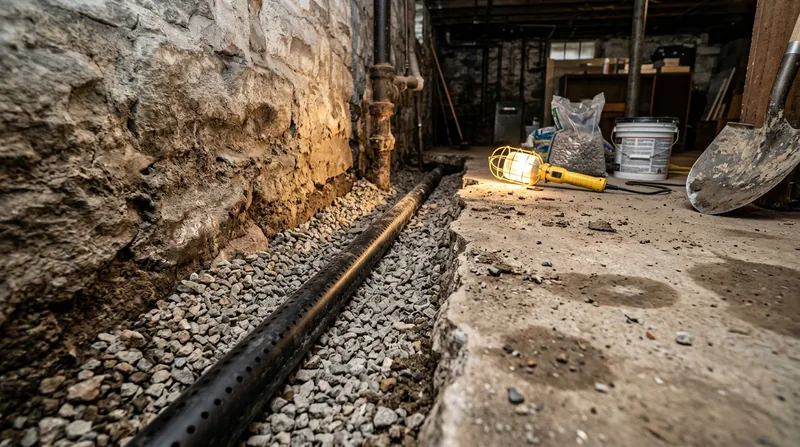




Interior Drain Tile System in Reading: Stopping Water at the Footing
An Interior Drain Tile System in Reading is the right answer when water rises under the slab and no crack sealing will ever stop it. Reading sits on clay-rich residual soil over shale and limestone, and the valley bottoms along the Schuylkill and the creeks hold a high water table. That means spring melt and heavy rain push water up against footings that were never designed for it, especially in the 1900s-1930s brick rowhouses and twins of the West End, Centre Park and Pennside. We cut the slab edge, capture water at the footing and pump it out through a sump basin. For the broader picture of how this fits with wall seepage and crack work, see our basement waterproofing service.
Why Interior Drain Tile Matters in Reading's Clay and Stone Cellars
Most wet basements in Reading are not a crack problem, they are a hydrostatic pressure problem. Water builds under the slab in glacial clay soil, finds the path of least resistance at the cove joint, and shows up as a wet perimeter after every storm. Stone and early block cellars in Pennside and the West End wick that water straight through the mortar. When a sump pump fails on top of that, the basement floods fast.
- Water seeping at the wall-floor joint after heavy rain points to water under the slab, not a wall crack.
- Efflorescence on brick or block walls tells you moisture is moving through the masonry, not just condensing.
- Shallow cellars in older rowhouses often have no footing drain at all, so an interior perimeter drain is the only realistic fix.
- A sump pump that runs constantly, or trips the breaker, signals a basin that is undersized for the water volume.
When the water is coming up from below, an interior system solves it at the source instead of chasing seepage from the inside wall.
Key info: In Sinking Spring and Wyomissing, many 1950s-1970s block basements sit on clay that holds water for days after a storm. Homeowners there often find the sump pit full and the pump cycling every few minutes during spring melt.
For the permit side of drainage work, the City of Reading codes office is the authority to check before any discharge line or sanitary connection is altered: City of Reading official site.
How We Install an Interior Drain Tile System in a Reading Basement
We start with a free basement inspection, because the layout of the slab, the footing depth and the existing sump location decide the whole plan. In a stone cellar we work carefully around the rubble foundation. In a poured basement in the newer townships we cut a clean trench at the slab edge. Either way, water is captured at the footing and carried to a basin, not left to pool.
- We inspect the basement perimeter, the cove joint, the existing sump basin and the discharge line, and check for bowing walls or active cracks.
- We set up containment and protection for the floor and any stored items before cutting.
- We cut a trench along the slab edge, typically 12 to 16 inches wide, down to the footing.
- We lay perforated drain tile in washed stone, wrapped in filter fabric to keep the clay fines out.
- We set or replace the sump basin at the low point and connect the tile to it.
- We install the sump pump, check valve and discharge line, then route discharge well away from the foundation.
- We backfill with stone, pour new concrete over the trench and test the system with water before we leave.
Every install is tested before we call it done, and we walk you through the check valve and discharge routing so you know what normal looks like.
Key info: A Centre Park rowhouse we worked on had a shallow cellar with no footing drain and a sump pit that filled within an hour of a storm. The interior perimeter drain moved that water to a new basin with a check valve, and the floor stayed dry through the next spring melt.
If your existing tile is crushed or clogged, we also handle drain tile repair and replacement before we quote a new system.
Interior Drain Tile Approaches Compared
Not every basement needs the same system. The table below shows the approaches we use in Reading and the conditions each one fits, so you can see where your basement lands.
| Approach | Description | Best for |
|---|---|---|
| Interior perimeter drain | Perforated tile in stone along the slab edge, feeding a sump basin. | Water under the slab and wet cove joints in clay soil. |
| Interior drain with dimple board | Drain tile plus a wall membrane that channels seepage down to the tile. | Stone and early block walls that wick moisture through the masonry. |
| Sump and discharge upgrade | New basin, pump, check valve and discharge routed away from the foundation. | A working tile system with an undersized or failing pump. |
| Exterior footing drain | Excavation down to the footing, new tile and waterproof membrane. | Bowing walls or a failing exterior membrane where digging is practical. |
| Crack injection only | Epoxy or polyurethane injection into a single active crack. | One isolated crack with no water under the slab. |
If your only symptom is one vertical crack and the floor stays dry, injection may be all you need, and we will tell you so.
Interior Drain Tile System Cost in Reading: What to Expect
Most interior drain tile work in Reading starts at from $50 per linear foot, and that figure covers the trench, tile, stone, fabric and concrete patch. A typical rowhouse perimeter runs 80 to 120 linear feet, so the job lands in a predictable range before add-ons. The number moves with the length of the run, the condition of the slab, whether we are cutting a poured floor or working around a rubble stone footing, and whether a new basin and pump are part of the scope.
- Footing depth and slab thickness change the labor, especially in stone cellars in Pennside and the West End.
- Replacing the sump basin, pump, check valve and discharge line adds to the total.
- Dimple board on wicking stone walls is a separate line item from the tile itself.
- Difficult access, tight cellar stairs or finished floors raise the labor share.
Get two or three written estimates and compare scope line by line, not just the bottom number. Our full pricing overview breaks down the components in more detail.
Interior Drain Tile System Near Me: Hiring a Waterproofing Contractor Near Reading
Hiring for below-grade work is different from hiring for a cosmetic job, because the system is buried and you cannot inspect it later. Ask for proof of licensing and insurance before anyone cuts your floor. Ask how the contractor handles the discharge line, because pumping water onto the same spot is a common failure. And ask for references from jobs in Berks County with the same basement type as yours.
- Confirm the contractor is licensed and insured, and request a certificate of insurance.
- Get two or three written estimates with the scope spelled out, not a verbal number.
- Check references from recent jobs in Reading, Wyomissing or Shillington.
- Ask who pulls any permit required for drainage or sump discharge work, and verify with the local building department.
If a contractor cannot answer those questions plainly, keep looking. You can reach us through our contact page to schedule a free inspection.
Interior Drain Tile System in Reading: Pricing Guide
| Service | Price | Details |
|---|---|---|
| Interior perimeter drain, standard run | Starting at $50/linear ft | Includes trench, perforated tile, washed stone, filter fabric and concrete patch along the slab edge. |
| Interior drain with dimple board on walls | Starting at $65/linear ft | Adds wall membrane that channels seepage down to the tile, priced by wall height and condition. |
| Sump basin and pump package | Starting at $1,200 | New basin, pump, check valve and discharge line; pump capacity and discharge distance move the price. |
| Complex or large-scale job | On estimate | Stone footings, finished floors or long perimeters need an on-site look before a firm number is given. |
| Travel | Included | In Reading and surrounding areas, no separate call-out or mileage fee. |
| Estimate | Free | Response within 24h at (610) 816-6520, no obligation to book. |
Indicative pricing, the exact cost depends on square footage, finish, and site access. Free personalized estimate within 24h at (610) 816-6520.


