



Vapor Barrier Installation in Reading: Stop Ground Moisture Before It Reaches Your Living Space
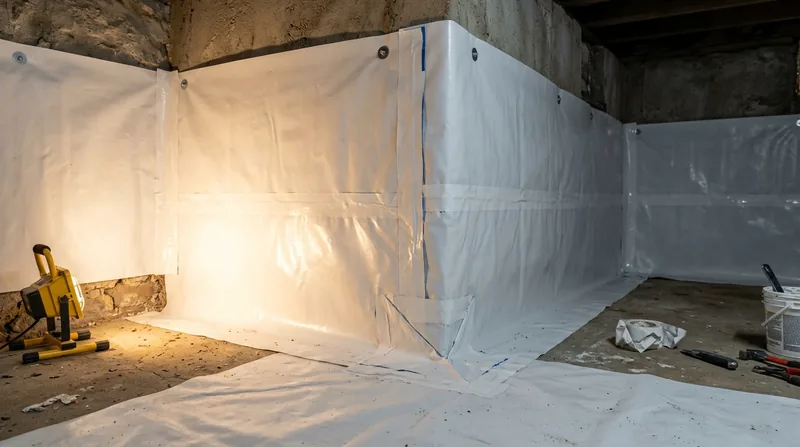
Reading's 1900s brick rowhouses and twins in the West End, Centre Park and Pennside sit on stone, brick and early block foundations, and the clay-rich residual soil over shale and limestone holds moisture against those walls year round. If your basement smells musty, if the lower block sweats in July, or if you see white efflorescence blooming on the mortar, the soil vapor is already finding a path in. Vapor Barrier Installation in Reading puts a heavy-duty sheet across the walls and slab, seals the seams and terminations, and cuts that vapor path off at the source. We install it as a standalone fix or as the finishing layer on a full basement waterproofing system. Call (610) 816-6520 to schedule a free basement inspection.
Why Vapor Barriers Matter in Reading's Clay and Stone Foundations
Berks County's clay soil does not drain the way sandy ground does. After a heavy rain or the spring melt, the water table along the Schuylkill and the creeks rises, and that moisture pushes vapor through stone, brick and early block walls that were never built with a modern membrane. The result is a damp, musty lower level and recurring mold growth on joists and stored goods. A properly sealed vapor barrier blocks that vapor before it enters the room.
- Stone and brick cellars in Centre Park and Pennside wick ground moisture through mortar joints that have already been through decades of freeze-thaw.
- 1950s to 1970s block basements in Wyomissing and Shillington show damp block faces and efflorescence even when no water pools on the floor.
- Poured basements in the newer townships pull vapor through hairline shrinkage cracks and cold joints.
- Valley-bottom homes near the creeks sit over a high water table that keeps the soil saturated long after the storm passes.
In every one of those cases, the barrier is the layer that turns a damp storage area into usable, dry space.
Key info: A homeowner in Pennside had efflorescence climbing the stone wall of a 1920s rowhouse and a musty smell that returned every summer. The wall was damp to the touch but no water stood on the floor. A sealed vapor barrier across the wall and slab, tied into the existing sump basin, dried the space out without any excavation.
Homeowners researching the building science behind moisture control can review the U.S. Department of Energy's guidance on moisture control in basements, and any work that alters drainage or sump discharge should be checked against the City of Reading's codes through the local building department.
How We Install a Vapor Barrier in a Reading Basement
We start by finding out where the moisture is actually coming from, because a barrier over an active leak traps water instead of stopping it. On a stone cellar in the West End we check the mortar joints and the base of the wall. On a block basement in Sinking Spring we look at the block faces and the floor-to-wall joint. Then we build the barrier to fit what we found.
- We walk the basement and identify vapor sources, active seepage and any wall movement before pricing the job.
- We clear the walls and slab and grind or patch rough mortar so the sheet sits flat and the seal holds.
- We hang heavy-duty barrier sheets across the walls and run them onto the slab, overlapping the seams by the manufacturer's spec.
- We seal every seam and termination with compatible tape and adhesive, and we mechanically fasten the top edge.
- We integrate the barrier with the sump basin and the interior drain so any water that does reach the floor still reaches the pump.
- We test the finished assembly and show you where the terminations sit before we pack up.
If the inspection turns up active seepage, we will tell you plainly that a barrier alone is not the answer and that an interior drain tile system has to go in first.
Key info: In a 1960s split-level in Wyomissing, the block walls were damp and the floor was dry, but the sump pit cycled after every storm. We installed the barrier with a sealed termination at the sump basin and a check valve on the discharge line, so the barrier and the pump worked as one system instead of fighting each other.
Vapor Barrier Approaches We Use in Berks County
Not every basement takes the same barrier. The right approach depends on the wall material, how much vapor is moving, and whether water is already reaching the floor. The table below shows the options we install most often in Reading and the surrounding boroughs.
| Approach | Description | Best for |
|---|---|---|
| Wall and slab vapor barrier | Heavy-duty sheet across the walls and floor with sealed seams and taped terminations. | Damp block or poured basements with no standing water |
| Barrier with dimple board | Dimple board holds the sheet off the wall and lets vapor drain down to the perimeter. | Stone and brick cellars with uneven mortar |
| Barrier tied to interior drain | Barrier termination meets the interior perimeter drain and sump basin as one system. | Basements with hydrostatic pressure and a working drain |
| Barrier with wall sealing | Cracks and joints are sealed before the barrier goes up over them. | Walls with visible seepage points and old parging |
| Full perimeter system | Barrier, drain tile and sump integrated across the whole basement perimeter. | Wet basements with recurring water after rain |
We will recommend the simplest option that actually solves your moisture problem, not the most expensive one on the list.
Vapor Barrier Installation Cost in Reading: What to Expect
Most vapor barrier work in Reading starts around $3 per square foot of covered wall and slab area, and the final number depends on how much prep the walls need, how many seams and terminations there are, and whether the barrier has to tie into a sump or drain. A small, clean block basement in Shillington sits at the low end. A stone cellar in Pennside with rough mortar and a sump integration sits higher.
- Wall condition drives the price: rough stone and failing parging take more prep than flat block or poured concrete.
- Access matters: a narrow rowhouse stair and a full basement of stored goods slow the crew down.
- Integration adds scope: tying the barrier into a sump basin or interior drain is more work than a wall-only sheet.
- Combining work saves money: installing the barrier alongside drain tile or wall sealing costs less than two separate visits.
Get two or three written estimates and compare the scope, not just the bottom line. Our full pricing overview breaks down the ranges we see across Berks County.
Hiring a Vapor Barrier Contractor Near Reading: What to Check
Vapor barrier work is only as good as the installation, so the contractor matters as much as the material. Ask for proof of licensing and insurance before anyone walks into your basement, and get the certificate sent to you, not just a verbal yes. Get at least two written estimates with the scope spelled out, and ask for references from jobs in Reading or a nearby borough.
- Confirm the company is licensed and insured, and ask for a certificate of insurance before work starts.
- Read the scope carefully: wall height covered, seam sealing method and sump integration should all be listed.
- Call references and ask whether the basement stayed dry through a full spring melt.
- Check whether a permit is required for any drainage or sump discharge changes, and let the local building department confirm the rule.
If a contractor will not put the scope in writing or cannot show insurance, keep looking. You can reach us through our contact page to set up a free inspection.
Vapor Barrier Installation in Reading: Pricing Guide
| Service | Price | Details |
|---|---|---|
| Wall and slab vapor barrier | Starting at $3/sq ft | Includes heavy-duty sheet, sealed seams and taped terminations; wall condition moves the price. |
| Barrier with dimple board | Starting at $4.50/sq ft | Adds dimple board for uneven stone or brick walls; prep and wall height set the rate. |
| Barrier tied to sump or interior drain | Starting at $5/sq ft | Includes sump basin integration and sealed termination; drain condition affects the final quote. |
| Complex or large-scale basement | On estimate | Full perimeter systems need an on-site look before we give a number. |
| Travel | Included | In Reading and surrounding areas, no separate call-out or mileage fee. |
| Estimate | Free | Response within 24h at (610) 816-6520, no obligation to book. |
Indicative pricing, the exact cost depends on square footage, finish, and site access. Free personalized estimate within 24h at (610) 816-6520.


