



Exterior Basement Waterproofing in Reading: Stopping Water at the Wall, Not in the Basement
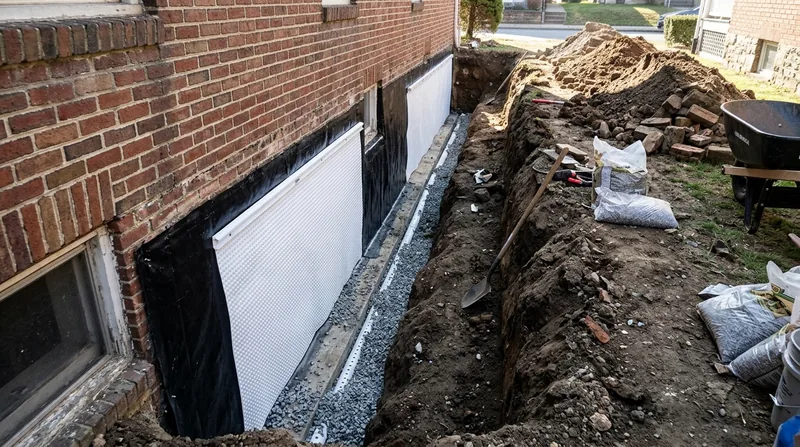
Reading sits in a valley where clay-rich residual soil over shale and limestone holds water against foundation walls long after the rain stops. The 1900s-1930s brick rowhouses and twins in the West End, Centre Park and Pennside were built with stone, brick or early block cellars, and many of those walls have been wicking moisture for a century. Exterior Basement Waterproofing in Reading means excavating down to the footing, applying a waterproof membrane or dimple board directly to the foundation wall, and correcting the grading and downspouts that send water there in the first place.
We handle this work as a dedicated below-grade specialist, not as a general foundation firm or a plumber. If a crack is the only problem, we say so and seal it. If hydrostatic pressure is driving water through the wall every spring, exterior excavation is the permanent answer, and we will tell you when an interior drain tile system makes more sense for your basement. Call Reading Waterproofing at (610) 816-6520 to schedule a free basement inspection.
Why Reading Basements Leak: Clay Soil, Creek Valleys and Old Brick Cellars
The ground across Berks County is heavy glacial clay over shale and limestone, and it does not drain quickly. In the valley bottoms along the Schuylkill and the creeks, the water table sits high, so after a heavy storm or the spring melt the soil around a foundation is saturated and pushing inward. Freeze-thaw cycles crack old mortar joints in stone and brick cellars, and that is where seepage starts.
- Clay soil traps water against the wall and creates hydrostatic pressure that no interior paint or sealer can hold back.
- Old brick and stone cellars in Centre Park and Pennside absorb water through mortar and show efflorescence on the inside face.
- Block basements in 1950s-1970s ranches in Wyomissing, Shillington and Sinking Spring wick moisture through porous block and settle at the footing joint.
- Downspouts that dump at the corner and grading that slopes back toward the house send roof water straight into the same soil.
When water shows up after every heavy rain, the fix belongs on the outside of the wall, at the footing, where the water actually arrives.
Key info: A twin in the West End with a stone cellar that seeped every March usually needs exterior excavation and a footing drain, not another coat of sealer on the inside face. We confirm that on site before anyone quotes a number.
For the state's guidance on home improvement contractors and consumer protections, see the Pennsylvania Office of Attorney General home improvement resources.
How We Do Exterior Basement Waterproofing in Reading, Step by Step
We start with a free basement inspection to find where the water enters and whether the problem is a crack, a failed footing drain, or pressure through the whole wall. Then we plan the excavation around your access, utilities and planting, because a rowhouse in Kenhorst and a split-level in Sinking Spring present very different digs. Every job ends with corrected grading and downspout extensions so the water leaves the wall for good.
- We locate the sewer, water and gas lines and mark the excavation limits before any soil is moved.
- We excavate down to the footing, typically 6 to 8 feet, and expose the full height of the foundation wall.
- We clean and repair the wall face, parging deteriorated mortar and sealing open cracks before any membrane goes on.
- We apply a waterproof membrane or dimple board directly to the wall and install or replace the footing drain.
- We backfill with free-draining material, regrade the surface away from the house, and extend downspouts well past the wall.
Where a window well sits below grade, we tie it into the drainage so it does not become a funnel, and we can review window well drainage and repair at the same visit.
Key info: On a 1920s twin in Shillington, the footing drain had collapsed and the downspout discharged at the same corner for decades. We replaced the drain, applied dimple board, and extended the downspout 8 feet out, and the basement has stayed dry through every spring thaw since.
Exterior Excavation Compared With Other Waterproofing Approaches
Exterior work is the most thorough option because it stops water before it reaches the wall, but it is not always the right call. This table shows how the main approaches compare so you can see where your basement fits.
| Approach | Description | Best for |
|---|---|---|
| Exterior membrane and footing drain | Excavate to the footing, waterproof the wall face, replace the drain | Walls that seep through the whole face under hydrostatic pressure |
| Interior perimeter drain tile | Cut the slab, install drain tile and a sump basin inside | Finished basements where exterior access is limited or costly |
| Crack injection | Epoxy or polyurethane injected through ports into a single crack | One clear vertical crack with no widespread seepage |
| Grading and downspout correction | Reslope soil away from the wall and extend discharge lines | Surface water that pools at the foundation after storms |
We recommend an interior drain tile system without hesitation when the basement is finished or the exterior dig would destroy a driveway or mature planting.
Exterior Basement Waterproofing Cost in Reading: What to Expect
Pricing for exterior work starts at $95 per linear foot, and that figure reflects excavation, wall preparation, membrane or dimple board, footing drain work and backfill. The final number depends on how many linear feet of wall are involved, how deep the footing sits, and how hard the site is to dig. A rowhouse in Reading with a shared wall and a narrow side yard costs more per foot than an open ranch in Wyomissing.
Access drives cost more than anything else. A dig that requires hand work next to a gas line, a driveway or a mature tree costs more than an open lawn. The age and condition of the wall matter too, because a stone cellar that needs parging and mortar repair before the membrane goes on takes longer than a poured wall. Getting two or three estimates is the smart move, and it lets you compare scope, not just the bottom line. See our full pricing overview for detail on how each line item is built.
Choosing an Exterior Basement Waterproofing Contractor Near Me in Reading
Start by confirming the contractor is licensed and insured for below-grade work and ask for a certificate of insurance before anyone breaks ground. Get at least two or three written estimates that describe the same scope, and ask each one whether they will pull the permits the local building department requires. Then check references from jobs in Berks County with the same kind of foundation as yours.
Permits are commonly required for structural foundation repair and for work that alters drainage or the sanitary connection of a sump discharge, and the thresholds vary by jurisdiction. Always verify with the local building department before work starts. Ask how the contractor handles a bowing wall if one turns up during excavation, and get the warranty terms in writing, including whether it transfers to a future owner. Reach out through our contact page to set up a free inspection and a written estimate.
Key info: If a contractor quotes exterior excavation without inspecting the inside of the basement first, walk away. The interior face tells us whether you are dealing with a crack, a failed drain, or pressure through the whole wall, and that changes the scope.
Exterior Basement Waterproofing in Reading: Pricing Guide
| Service | Price | Details |
|---|---|---|
| Exterior waterproofing, standard access | Starting at $95/linear ft | Includes excavation to footing, membrane or dimple board, footing drain work and backfill |
| Exterior waterproofing with difficult access | Starting at $125/linear ft | Hand digging near utilities, driveways or shared rowhouse walls adds labor and time |
| Stone or brick cellar wall preparation | On estimate | Parging and mortar repair needed before the membrane can be applied to an old wall |
| Footing drain replacement | Starting at $45/linear ft | New perforated drain and gravel surround where the original weeping tile has collapsed |
| Grading and downspout correction | Starting at $850 | Reslope soil away from the wall and extend downspout discharge lines past the foundation |
| Free basement inspection | Free | On-site evaluation and written estimate, response within 24 hours at (610) 816-6520 |
Indicative pricing, the exact cost depends on square footage, finish, and site access. Free personalized estimate within 24h at (610) 816-6520.


