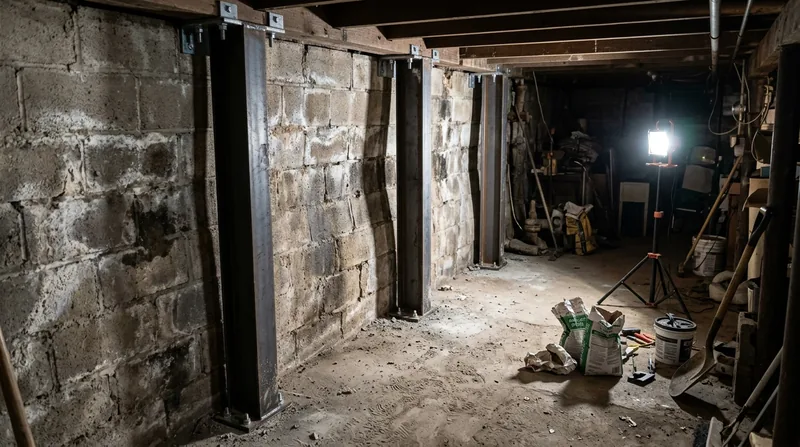




Bowing Wall Repair in Reading: When a Foundation Wall Starts to Lean
If you have noticed a basement wall pushing inward, cracking along the mortar joints, or a visible curve when you hold a level against it, you are looking at a structural problem that gets worse with every wet season. Bowing Wall Repair in Reading is not a cosmetic fix. It is a stabilization job that has to match the actual pressure behind the wall, and in Berks County that pressure comes from clay-rich residual soil sitting over shale and limestone, plus a water table that rises fast along the Schuylkill and the creeks after heavy rain.
Reading's building stock makes this a common call. The 1900s-1930s brick rowhouses and twins in the West End, Centre Park and Pennside often have stone, brick or early block cellars that were never designed for today's saturated ground. The 1950s-1970s ranches and split-levels in Wyomissing, Shillington and Sinking Spring sit on block basements that show the same failure after a hard winter. Stone farmhouses with fieldstone walls across the county are a category of their own. We assess the wall, the soil and the drainage together before we recommend a repair method. For a broader look at how moisture reaches these walls, see our basement waterproofing service.
Why Bowing Walls Are So Common in Reading's Clay and Freeze-Thaw Cycle
A bowing wall is almost always a pressure story, not a materials story. Clay soil holds water instead of draining it, and when that clay is saturated it expands and pushes laterally against the wall. In Reading, the freeze-thaw cycle adds a second punch: water in the soil and in old mortar freezes, expands, and opens joints that were already tired. Spring melt and heavy rain then drive more water into the same clay, and the wall moves a little more each cycle.
- Hydrostatic pressure builds when saturated clay has nowhere to drain and pushes the wall inward.
- Freeze-thaw cracking opens old mortar joints in brick and stone cellars, letting water reach the wall core.
- Failed or missing drain tile at the footing lets water sit against the base of the wall instead of carrying it away.
- Downspout and grading issues concentrate roof water at the foundation, especially on tight rowhouse lots.
- Efflorescence and wall seepage are early warning signs that moisture is already moving through the masonry.
Treating the symptom (a crack, a damp patch) without addressing the pressure behind the wall is how a small lean becomes a structural emergency. For official guidance on structural permits, check the City of Reading building department before any structural work begins.
Key info: In Pennside and the West End, we routinely find 1920s brick cellars where the wall has bowed 1 to 2 inches over decades, and the homeowner only notices after a wet spring when the interior parging cracks and white efflorescence appears along the mortar lines.
How We Diagnose and Repair a Bowing Wall in Reading
Every repair starts with a measurement, not a guess. We check the wall with a plumb line and a level, map the cracks, and look at the soil and drainage on the outside. The method we recommend depends on how far the wall has moved, whether it is still moving, and what is driving the pressure. A wall that has moved less than an inch with no active cracking is a different job from a wall that has bowed three inches and is pulling away from the floor joists.
- We inspect the wall, the footing and the drainage, and we measure the amount and direction of movement.
- We identify the pressure source: clay, water table, failed drain tile, or a combination.
- We match the repair to the severity: carbon fiber straps for minor to moderate bowing, steel I-beams for heavier loads, wall anchors where the outside soil can be reached.
- We correct the water management so the repair is not fighting the same pressure next spring.
- We verify the wall is stable and document the work for your records and any required permit inspection.
The right repair stabilizes the wall. It does not reverse the bow, and any contractor who promises to push a wall straight back is selling you something the soil will undo. For walls where water is the primary driver, our foundation waterproofing work often runs alongside the structural repair.
Key info: On a 1960s split-level in Sinking Spring, a block wall had bowed about 1.5 inches after years of clay pressure and a clogged footing drain. We installed carbon fiber straps on the interior and restored drainage at the base, and the wall has held its position through two spring melt seasons.
Repair Methods We Use and When Each One Fits
| Approach | Description | Best for |
|---|---|---|
| Carbon fiber straps | Straps bonded vertically to the interior wall and anchored at the floor and ceiling to resist further inward movement. | Minor to moderate bowing on block and poured walls with no active movement. |
| Steel I-beams | Vertical steel beams set against the wall and tied into the floor structure to carry heavy lateral loads. | Heavier bowing, long walls, and walls where carbon fiber alone is not enough. |
| Wall anchors | Anchors driven into stable soil outside the wall and connected through the wall to a plate on the inside. | Walls where the exterior is accessible and the soil can hold an anchor. |
| Drainage correction | Repair or replacement of footing drain, grading and downspout discharge to relieve hydrostatic pressure. | Any bowing wall where water is the driving force, paired with the structural repair. |
We choose the method after measuring the wall, not before. In older Reading rowhouses, the right answer is often carbon fiber plus drainage correction, while a fieldstone farmhouse wall may need a different approach entirely. If the wall is wet as well as bowed, our foundation crack repair work is usually part of the same visit.
Bowing Wall Repair Cost in Reading: What to Expect
Bowing wall repair is priced by the linear foot of wall and by the method, not by a flat rate. As a starting point, minor crack and strap work begins from $600, and the number climbs with the length of the wall, the severity of the bow, and whether drainage has to be corrected at the same time. A single strap on a short block wall is a very different job from a full wall of steel I-beams on a 1920s brick cellar.
The factors that move the price are consistent across Reading and Berks County:
- Wall length and height determine how many straps or beams the job needs.
- Severity of movement decides whether carbon fiber is enough or steel is required.
- Access matters on tight rowhouse lots in the West End and Centre Park, where equipment cannot be staged easily.
- Wall material changes the labor: fieldstone and old brick take more time than poured concrete.
- Drainage correction adds cost but is often what keeps the repair from failing.
Get two or three written estimates and compare the method, not just the total. A low bid that skips drainage correction is not the same scope as one that addresses the pressure behind the wall. Our pricing overview explains how we build an estimate.
Bowing Wall Repair Near Me: How to Vet a Contractor Near Reading
When you search for bowing wall repair near me, the list of names can look interchangeable. It is not. Structural repair is a licensed trade, and the contractor you hire should be able to explain the method, show you the measurement, and tell you plainly when a simpler fix is enough. Use these checks before you sign anything.
- Confirm the contractor is licensed and insured for structural work in Pennsylvania, and ask for a certificate of insurance.
- Get at least two or three estimates, and make sure each one names the repair method and the linear footage.
- Ask for local references from jobs in Reading, Wyomissing or Shillington, and call them.
- Ask who pulls the permit, because structural foundation repair commonly requires one and thresholds vary by jurisdiction.
- Check HOA requirements if you live in a newer township subdivision before exterior work begins.
A contractor who cannot answer these questions clearly is not the one to trust with a structural wall. If you want to talk through your situation, contact us and we will set up a free inspection.
Bowing Wall Repair in Reading: Pricing Guide
| Service | Price | Details |
|---|---|---|
| Crack injection and minor stabilization | Starting at $600 | Covers small crack injection and limited strap work on a short wall section, priced by linear foot. |
| Carbon fiber strap installation | Starting at $1,200 | Includes straps bonded to the interior wall and anchored top and bottom, priced per strap and wall length. |
| Steel I-beam reinforcement | Starting at $2,800 | Heavy-duty beams tied into the floor structure for significant bowing, priced by beam count and wall height. |
| Wall anchor system | On estimate | Requires an exterior soil assessment and access, so the scope is set after an on-site look. |
| Drainage correction add-on | On estimate | Footing drain repair or grading work priced separately once the pressure source is confirmed on site. |
| Estimate | Free | Response within 24h at (610) 816-6520, no obligation to book. |
Indicative pricing, the exact cost depends on square footage, finish, and site access. Free personalized estimate within 24h at (610) 816-6520.


