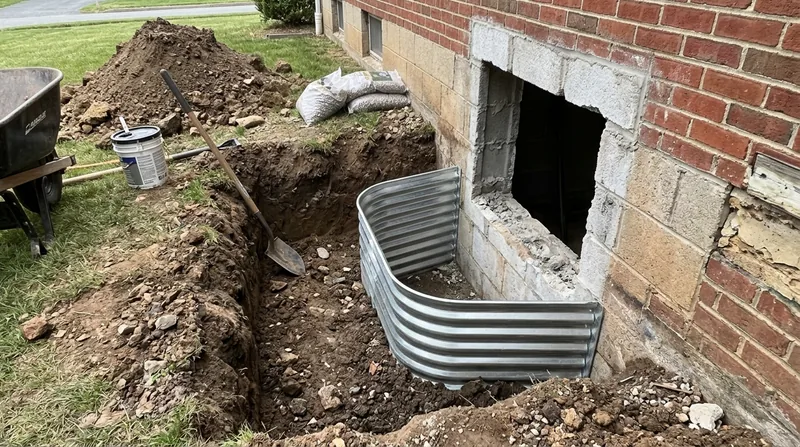




Egress Window Installation in Reading is the piece most homeowners forget until the basement finish is already framed and the inspector asks where the bedroom window is. In this city the answer is rarely simple: 1900s to 1930s brick rowhouses and twins in the West End, Centre Park and Pennside often sit on shallow cellars or full stone and early block basements, and cutting a code-sized opening through that wall is a different job than cutting a poured wall in a township subdivision. The ground here is clay-rich residual soil over shale and limestone, and the valley bottoms along the Schuylkill and the creeks hold a high water table, so every new opening has to be flashed and drained, not just cut. We cut, frame, flash and drain egress windows so a new sleeping room or living space stays dry through the spring melt and the summer storms that swell the creeks. If you are still planning the finish, pair this with basement waterproofing before the drywall goes up.
Why Egress Window Installation Matters in Reading's Old Cellars and Block Basements
Reading's housing stock was not built with escape openings in mind. A stone cellar wall under a West Reading rowhouse may be 18 inches thick with rubble core, and a 1950s block basement in Shillington or Sinking Spring is often only 6 to 8 inches of block with a shallow footing. The opening has to be sized for a person to get out, and the well outside it has to move water away from the new hole in the wall.
- We verify the rough opening meets the current escape and rescue size requirements before any saw touches the wall.
- We cut through brick, stone, block or poured concrete with the right blade and dust control for that material.
- We frame the opening with treated lumber and flash the sill and jambs against wind-driven rain.
- We tie the window well into drainage so water does not sit against the new foundation cut.
- We coordinate the permit with the local building department, because egress window cutting is commonly permitted work and thresholds vary by jurisdiction.
Done in the right order, the window and the drainage are one job, not two, and the basement stays dry after the first hard rain.
Key info: A Centre Park rowhouse we worked on had a 14-inch stone cellar wall and a window well that filled with roof runoff during every storm. We cut the egress opening, flashed the sill, and tied the well to a gravel and drain line before the homeowner framed the new bedroom. The wall stayed dry through the next spring melt.
For the current escape and rescue opening requirements, check the City of Reading codes and permits page before you finalize the layout: City of Reading official website.
How We Cut, Frame and Drain an Egress Window in Reading
The sequence matters more than the saw. On a Wyomissing split-level with a block basement, we start by locating the footing and any utilities, then set the opening height so the well can be built without undercutting the footing. On a poured-wall subdivision basement, the cut is cleaner but the flashing still has to shed water away from the wall. We treat the window as a waterproofing detail first and a window second.
- We inspect the basement wall, footing and exterior grade, and confirm the opening location with you and the permit drawing.
- We cut the rough opening to the required escape size, protecting the wall above and the floor below.
- We frame the opening in treated lumber and set the window with a sloped sill and proper flashing.
- We build the window well, seal it to the wall, and connect it to drainage so it does not hold water.
- We finish the interior jamb and sill and leave the opening ready for insulation and drywall.
Every opening we cut gets the same treatment at the wall-to-well joint, because that seam is where leaks start.
Key info: In Sinking Spring, a homeowner wanted a bedroom window in a 1960s block basement. The first contractor quoted a cut only. We found the window well would sit below the downspout discharge, so we extended the downspout and tied the well to a gravel drain before the cut. That detail is why the job stayed dry.
If the wall around the new opening shows efflorescence or seepage, the window is the moment to address it with window well drainage and repair rather than after the drywall is closed.
Egress Window Approaches We Use in Reading
Not every basement wall takes the same method. Stone and brick cellars need a slower, more careful cut and more flashing detail than a poured wall, and the well design changes with the grade outside. The table below shows the approaches we use across Reading and the surrounding boroughs.
| Approach | Description | Best for |
|---|---|---|
| Masonry saw cut with lintel | Slow cut through stone or brick with a steel lintel to carry the wall above | 1900s rowhouses and twins in the West End and Centre Park |
| Block wall cut and frame | Cut the block, frame in treated lumber, flash the sill and jambs | 1950s to 1970s block basements in Shillington and Sinking Spring |
| Poured wall cut with epoxy-sealed sill | Clean saw cut, sealed sill and jamb detail against the clay soil | Newer township subdivisions with poured basements |
| Well with gravel and drain line | Window well tied to a gravel bed and drain so it does not hold water | Low-lying lots near the Schuylkill and the creeks |
We pick the approach after we see the wall and the grade, not from a photo.
Egress Window Installation Cost in Reading: What to Expect
Most egress window projects in Reading start at From $4,500 for a standard opening in a block or poured wall with a basic well. That figure moves with wall thickness, material, well depth and how much drainage work the outside grade needs. A stone cellar wall in Pennside or a shallow cellar under an older rowhouse takes more time and more flashing detail than a clean poured wall in a Wyomissing subdivision. Getting two or three estimates is smart, because a quote that covers only the cut will leave you paying separately for the well and the drainage.
We put the full range on our pricing page so you can compare scope, not just the number. The cheapest quote is often the one that leaves the well undrained.
Finding Egress Window Installation Near Me in Reading: What to Check Before You Hire
Egress window work touches structure, waterproofing and permits at the same time, so the contractor you hire should be able to speak to all three. Ask for the license and insurance certificate, and confirm the permit will be pulled in the company's name. Ask for references from jobs in Reading or the surrounding boroughs, and ask how they handle the window well drainage, not just the cut.
- Confirm the company is licensed and insured, and ask for the certificate before work starts.
- Get two or three written estimates that separate the cut, the window, the well and the drainage.
- Check references on jobs with the same wall type as yours, stone, block or poured.
- Ask who pulls the permit, because egress window cutting is commonly permitted and rules vary by jurisdiction.
If a quote does not mention the well or the flashing, ask why before you sign. You can reach us through the contact page to set up a free inspection.
An egress window is a structural cut and a waterproofing detail in one. We treat it that way, and we tell you plainly when the wall needs crack repair or drainage work before the window goes in. Call Reading Waterproofing at (610) 816-6520 to schedule a free basement inspection in Reading.
Egress Window Installation in Reading: Pricing Guide
| Service | Price | Details |
|---|---|---|
| Standard block or poured wall egress window | Starting at $4,500 | Includes cut, treated frame, window set, flashing and a basic window well with drainage tie-in. |
| Stone or brick cellar wall egress window | Starting at $6,200 | Slower cut through thick masonry with a lintel and heavier flashing detail at the sill and jambs. |
| Deep well with gravel and drain line | Starting at $5,400 | For low-lying lots near creeks where the well must move water away from the new opening. |
| Complex or multi-opening job | On estimate | Several openings, tight access or structural reinforcement need an on-site look before we price it. |
| Travel | Included | in Reading and surrounding areas, no separate call-out or mileage fee |
| Estimate | Free | Response within 24h at (610) 816-6520, no obligation to book |
Indicative pricing, the exact cost depends on square footage, finish, and site access. Free personalized estimate within 24h at (610) 816-6520.


