



Foundation Waterproofing in Reading: Stop Water at the Wall, Not at the Sump
Foundation Waterproofing in Reading starts with one honest question: where is the water actually coming from? In this city, most wet basements trace back to clay-rich residual soil sitting over shale and limestone, a high water table along the Schuylkill and the creeks, and masonry walls that have been wicking moisture since the 1920s. We work on block, poured, brick and fieldstone foundations, and we match the fix to the wall, not the other way around.
Reading is not one housing market. The West End, Centre Park and Pennside hold 1900s to 1930s brick rowhouses and twins, many with stone or early block cellars. Wyomissing, Shillington and Sinking Spring carry 1950s to 1970s ranches and split-levels on block. Newer township subdivisions sit on poured walls. Each one fails differently, and each one needs a different answer. Call Reading Waterproofing at (610) 816-6520 and we will tell you which one you have.
Why Foundation Waterproofing Matters More in Reading Than in Most PA Cities
The dominant failure mode here is hydrostatic pressure against old masonry after a soaking rain. Clay soil holds water instead of draining it, the water table in the valley bottoms rises fast, and the freeze-thaw cycle opens mortar joints that were already soft. By the time you see water on the floor, the wall has usually been saturated for days.
- Efflorescence and white salt bloom on brick or block tells you moisture is moving through the wall, not around it.
- Hairline cracks in poured walls in the newer subdivisions often seep only during spring melt and heavy summer storms.
- Fieldstone farmhouse walls across Berks County leak through the mortar, not the stone, and need period-appropriate repointing and parging.
- A musty basement smell after rain usually means damp masonry, not a failed sump pump, and the two get confused constantly.
- Downspouts that dump within three feet of the foundation push roof water straight into the same clay that is already holding groundwater.
Sorting those causes before anyone quotes a number is the difference between a repair that holds and one that comes back next spring.
Key info: A 1920s brick twin in the West End with white bloom across the lower block and water only after two-day storms usually needs crack and mortar sealing plus grading correction, not a full perimeter drain. A 1960s Shillington ranch with water across the whole floor within an hour of rain is a hydrostatic pressure problem and needs drainage. Same city, opposite answers.
For the regulatory side, structural foundation repair and any work that alters drainage or the sanitary connection of a sump discharge commonly require a permit in Pennsylvania, and thresholds vary by municipality. Always confirm with the City of Reading codes office or your township building department before work starts: City of Reading official site.
How We Diagnose and Waterproof a Reading Foundation, Step by Step
We start below grade and work outward. The first visit is a walk of the basement perimeter, the exterior grade, the downspout terminations and the window wells, plus a look at the wall itself for efflorescence, spalling, bowing and crack orientation. We check whether the existing drain tile or footing drain is still flowing or silted shut. Then we tell you plainly whether simple crack sealing is enough or whether the real problem is pressure.
- We map every water entry point on the wall and floor, including cold joints and tie holes in poured walls.
- We test drainage by observing the sump basin and discharge line during flow, and we check the check valve for backflow.
- We correct grading and downspout extensions first, because moving roof water away is the cheapest fix that actually works.
- We seal active cracks with epoxy injection for structural cracks or polyurethane injection for leaking ones, using injection ports set along the crack.
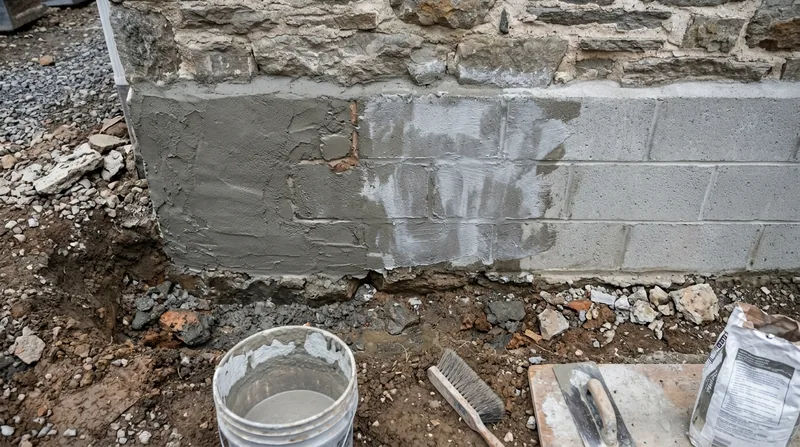
- We apply parging or a waterproof membrane to masonry walls where the surface itself is the path, and crystalline treatment where the wall is damp but sound.
- We install or repair interior perimeter drain and drain tile where hydrostatic pressure is the driver, tying it to a properly sized sump basin and pump.
- We confirm the discharge line runs to a legal daylight or storm point and that the check valve holds.
Every step is documented, so you know what was done to your wall and why. If you want the full sequence on interior work, see our interior drain tile system page.
Key info: On a fieldstone farmhouse outside Kutztown, we repointed soft mortar and parged the interior face before adding drainage. On a poured-wall split-level in Sinking Spring, the fix was two epoxy-injected cracks and a downspout extension. Same county, same rain, two completely different scopes.
Foundation Waterproofing Methods We Use and When Each One Fits
There is no single product that solves every Reading basement. The table below shows how we match the method to the wall type and the water source, which is the decision that drives both the scope and the price.
| Approach | Description | Best for |
|---|---|---|
| Epoxy or polyurethane injection | Ports set along the crack and resin pumped in to fill it full depth. | Poured wall cracks that seep after rain |
| Parging and masonry repair | Repointing soft mortar and applying a bonded parge coat to the wall face. | Brick and fieldstone walls with porous mortar |
| Waterproof membrane or dimple board | Exterior membrane applied to the wall face with drainage board over it. | Exterior excavation where the wall is exposed |
| Crystalline treatment | Surface-applied treatment that seals the capillary pores in concrete. | Damp but structurally sound block or poured walls |
| Interior perimeter drain | Drain tile at the footing line feeding a sump basin and pump. | Hydrostatic pressure across the whole floor |
We recommend the least invasive method that actually solves your problem, and we will say so when a cheaper fix will hold.
Foundation Waterproofing Cost in Reading: What to Expect
Foundation waterproofing in Reading starts from $3,500 for a focused scope such as crack injection plus grading and downspout correction on a single wall. Whole-perimeter interior drainage with a new sump basin and pump runs higher, and exterior excavation on a fieldstone wall is the highest tier because of the labor and the masonry work. The number is driven by wall length, wall type, access, and how much of the failure is pressure versus surface seepage.
- Wall type matters most: fieldstone and brick take longer than poured concrete.
- Access matters next: a rowhouse with a shared alley is a different job than a ranch with open grade.
- Scope of drainage matters: a single crack is not the same as a full interior perimeter drain.
- Existing conditions matter: silted drain tile or a failing sump pump adds work before the new system goes in.
Get two or three written estimates and compare the scope line by line, not just the total. Our full breakdown is on the pricing page, and the free inspection is where we confirm which tier your basement actually falls into.
Choosing a Foundation Waterproofing Contractor Near Me in Reading
Ask three things before you sign anything: is the company licensed and insured, will they put the scope in writing, and can they explain why they chose that method over the alternatives? A contractor who only sells one system will sell you that system whether it fits or not. Ask for references from jobs in Reading or Berks County and call them.
- Confirm licensed and insured status and ask for a certificate before work begins.
- Get at least two estimates and compare what is included, not just the bottom line.
- Ask whether a permit is required for structural repair or drainage changes and who pulls it.
- Check references for jobs on your wall type, not just any job.
- Ask what the warranty covers and whether it transfers if you sell the home.
If a contractor cannot answer those questions plainly, keep looking. You can reach us through the contact page or at (610) 816-6520 to schedule a free basement inspection.
Foundation Waterproofing in Reading: Pricing Guide
| Service | Price | Details |
|---|---|---|
| Crack injection and surface sealing | Starting at $3,500 | Covers epoxy or polyurethane injection on active cracks plus parging or crystalline treatment on the affected wall section. |
| Interior perimeter drain and sump | Starting at $6,500 | Full interior drain tile, sump basin and pump; price moves with wall length and access around the perimeter. |
| Exterior membrane and drainage | Starting at $9,500 | Excavation, membrane or dimple board, and footing drain; fieldstone walls and tight rowhouse access push it higher. |
| Complex or large-scale job | On estimate | Bowing walls, multiple wall types, or combined interior and exterior work need an on-site look before pricing. |
| Travel | Included | In Reading and surrounding Berks County areas, no separate call-out or mileage fee. |
| Estimate | Free | Response within 24h at (610) 816-6520, no obligation to book. |
Indicative pricing, the exact cost depends on square footage, finish, and site access. Free personalized estimate within 24h at (610) 816-6520.


