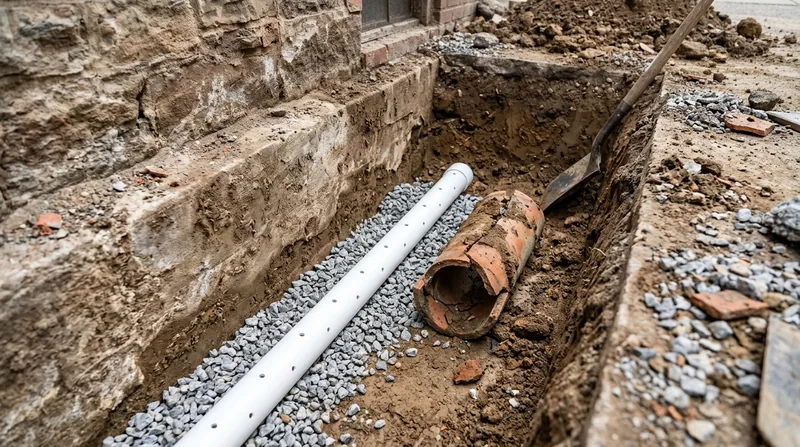




Reading sits in a valley where the Schuylkill River and its creeks swell fast after heavy rain, and the clay-rich soil over shale and limestone holds that water against your foundation long after the storm passes. If your basement takes on water at the cove joint or the floor stays damp weeks into spring, the problem is often the original footing drain, not the wall itself. Drain Tile Repair & Replacement in Reading means finding out whether the old clay tile under your footing is crushed, root-bound, or silted shut, and replacing it with modern perforated PVC that actually carries water to the sump. We work on 1900s brick rowhouses in the West End and Centre Park, 1950s ranches in Wyomissing and Shillington, and newer poured basements out in the townships. Start with a free basement inspection so we can tell you whether you need a repair, a full replacement, or an interior perimeter drain instead.
Why Drain Tile Problems Hit Reading Basements So Hard
Most of the drain tile still under Reading homes went in 60 to 100 years ago. It is clay tile laid in short lengths with open joints, and after decades of freeze-thaw cycles cracking old mortar and shifting the soil, those joints fill with silt and fine clay. Tree roots find the moisture and work their way in. Once the run is blocked, hydrostatic pressure builds under the slab and the water has nowhere to go but up through the floor or against the wall.
- Original clay tile collapses or silts shut and stops draining the footing entirely.
- Tree roots from street maples and backyard oaks invade open tile joints and choke the run.
- High water table in the valley bottoms along the Schuylkill and the creeks keeps the drain loaded even in dry spells.
- Older rowhouses with shallow cellars often have no footing drain at all, just a stone foundation sitting in wet clay.
- Downspouts and grading that dump roof water next to the wall overload whatever drain is left.
When the run is dead, no amount of patching the floor or sealing the wall will stop the water. The drain has to be restored or replaced.
Key info: A stone farmhouse outside Mohnton had a fieldstone foundation and a footing drain that had not moved water in decades. The cellar floor seeped every spring melt. Camera inspection showed the clay tile was collapsed in two runs, and targeted replacement with PVC plus a new sump basin dried the floor out.
For the official word on what work needs a permit in the City of Reading, check the City of Reading building department before any excavation or discharge line change.
How We Diagnose and Repair Drain Tile in Reading
We do not guess at a drain problem. The first step is a camera inspection of the existing run, pushed from the sump basin or a cleanout, so we can see exactly where the tile is crushed, root-bound, or silted. From there we map the footing line, check the wall for efflorescence and seepage height, and decide whether a targeted repair will restore the run or whether the whole perimeter needs replacement.
- We camera-inspect the existing drain tile and mark every blockage, break, and root intrusion.
- We check the sump basin, pump, and check valve to confirm the discharge end is working.
- We excavate only where the run has failed, keeping the disruption tight to the footing.
- We replace failed clay tile with perforated PVC set in washed stone and wrapped in filter fabric.
- We tie the new run into the sump basin, test flow, and confirm the discharge line carries water away from the foundation.
If the inspection shows the wall itself is taking hydrostatic pressure across a long span, we will tell you plainly that an interior drain tile system is the better answer than chasing failed exterior tile under a mature yard.
Key info: A 1920s twin in Pennside had water standing against the front wall every time the creek rose. The camera showed the original clay tile was intact but root-bound under a street maple. We cut out the root-bound section, replaced it with PVC, and the floor stayed dry through the next spring melt.
Drain Tile Repair Methods We Use in Reading
Not every failed drain needs the same fix. The right approach depends on how much of the run has failed, how deep the footing sits, and whether the problem is a single break or a whole perimeter that has silted shut. Here is how the options compare on real Reading jobs.
| Approach | Description | Best for |
|---|---|---|
| Targeted spot repair | Cut out one failed section of clay tile and splice in PVC with new stone and fabric. | A single crush or root intrusion on an otherwise sound run. |
| Full perimeter replacement | Excavate the footing line and replace the entire run with perforated PVC. | Old clay tile silted or collapsed along most of the foundation. |
| Interior perimeter drain | Break out the floor edge, install a new drain inside the footing, and tie it to the sump. | Exterior excavation is impractical or the wall takes heavy hydrostatic pressure. |
| Sump and discharge upgrade | New sump basin, pump, check valve, and discharge line sized to the drain. | The drain works but the pump cannot keep up or the discharge line is undersized. |
We size the approach to the actual failure, so you are not paying for a full perimeter replacement when a spot repair will restore the run.
Drain Tile Repair & Replacement Cost in Reading: What to Expect
Most drain tile repairs in Reading start at $750 for a targeted spot repair, and a full perimeter replacement runs considerably higher depending on length, depth, and access. The biggest cost drivers are how much of the run has failed, how deep the footing sits, whether the excavation is under a finished patio or a mature yard, and whether the sump and discharge line need upgrading at the same time.
- Length of the failed run and whether it is a spot repair or full replacement.
- Depth of the footing and how much soil has to come out.
- Access for excavation equipment around mature trees and tight rowhouse lots.
- Whether the sump basin, pump, and discharge line are part of the job.
- Whether the wall also needs crack injection or sealing once the drain is restored.
Get two or three estimates and make sure each one includes a camera inspection, because a number given without seeing the run is a guess. Our full pricing overview breaks down the ranges in more detail.
Hiring a Drain Tile Contractor Near Me in Reading: What to Check
Drain tile work is below grade and mostly invisible once the job is backfilled, so the contractor you hire matters more than the price on the first estimate. Ask for proof of licensing and insurance, and ask whether the crew doing the work is the same crew that inspected it. Get at least two or three written estimates with the scope spelled out, and ask each contractor to show you the camera footage they based the number on.
- Confirm the contractor is licensed and insured and can provide a certificate on request.
- Ask for references from jobs in Reading and the surrounding boroughs.
- Check that any excavation or discharge line change is permitted through the local building department.
- Make sure the estimate lists the camera inspection, the excavation, the pipe material, and the sump tie-in separately.
- Ask how the crew will protect mature trees and how they will restore the yard after backfill.
If a contractor will not put the scope in writing or cannot explain why they chose a repair over a replacement, keep looking. You can contact us for a free estimate and we will show you the footage and walk you through the options.
One more local note: in older Reading neighborhoods, the sump discharge line often runs to a sanitary connection that the city requires you to keep separate from storm drainage. Confirm the discharge route with the building department before the crew ties in the new line.
Drain Tile Repair & Replacement in Reading: Pricing Guide
| Service | Price | Details |
|---|---|---|
| Targeted spot repair | Starting at $750 | Cut out one failed section of clay tile, splice in PVC with stone and fabric |
| Full perimeter replacement | Starting at $3,200 | Excavate footing line and replace the full run with perforated PVC |
| Interior perimeter drain | Starting at $4,500 | Break out floor edge, install new drain inside footing, tie to sump |
| Sump and discharge upgrade | Starting at $1,200 | New sump basin, pump, check valve, and discharge line sized to the drain |
| Complex or large-scale job | On estimate | Deep footings, tight rowhouse lots, or finished-yard excavation need an on-site look |
| Estimate | Free | Camera inspection and written scope, response within 24h at (610) 816-6520 |
Indicative pricing, the exact cost depends on square footage, finish, and site access. Free personalized estimate within 24h at (610) 816-6520.


