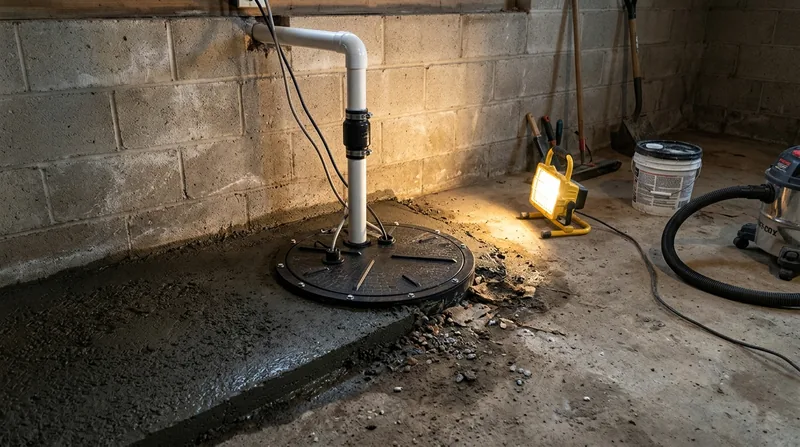




Sump Pump Installation & Replacement in Reading
Sump Pump Installation & Replacement in Reading is the work that keeps a wet basement from becoming a flooded one, and in this city the pump earns its keep. Reading sits in a valley where the Schuylkill and its creeks swell fast after heavy rain, and the clay-rich residual soil over shale and limestone holds that water against foundations for days. The 1900s-1930s brick rowhouses and twins in the West End, Centre Park and Pennside have stone, brick or early block cellars that were never built to shed water. The block basements in Wyomissing, Shillington and Sinking Spring and the poured basements in the newer township subdivisions face the same water table. We install and replace sump pumps, basins, check valves and discharge lines sized for that reality. If you want the full picture of how a pump fits into a dry basement, start with our basement waterproofing service.
Why Sump Pump Failure Hits Reading Basements Harder Than Most
Most sump pumps in Berks County die at the worst possible moment: during a storm, when the creeks are up and the water table is already high. A pump that has run quietly for years sits idle through dry spells, then gets hammered for 48 hours straight after a spring melt or a summer downpour. The old cast-iron or shallow-basin setups in the rowhouse cellars of Centre Park and Pennside were never sized for that load. Neither were the builder-grade pumps in 1970s split-levels in Sinking Spring.
- Water table rises fast in the valley bottoms along the Schuylkill and the creeks, so the pump cycles constantly during storms.
- Freeze-thaw cycles crack old mortar and open paths for water at the cove joint, where the wall meets the floor.
- Clay soil sheds water slowly, meaning the pump keeps running long after the rain stops.
- Shallow cellars in some older rowhouses leave little room for a proper basin, so the basin and pump must be sized to fit.
- A failed check valve sends water back into the basin and short-cycles the pump until the motor burns out.
A pump that trips its breaker or runs continuously is a warning, not a nuisance, and it usually means the basin, the pump or the discharge line is undersized for the water the foundation is taking on.
Key info: In Pennside and along the lower creeks, we routinely find 1/3 HP builder pumps trying to move water that needs a 1/2 HP or 3/4 HP unit with a sealed basin. The pump was never the problem. The sizing was.
For the code side, sump discharge and drainage alterations are commonly permitted at the local level, and the City of Reading codes office is the authority to check before work begins. Rules vary by jurisdiction, so verify the current requirement with the City of Reading before scheduling.
How We Install or Replace a Sump Pump in a Reading Basement
We start by finding out where the water actually comes from, because a pump without a collection path just moves the puddle around. On a stone cellar in the West End, that may mean cutting a new basin at the low corner and tying it to an interior perimeter drain. On a poured basement in a newer Wyomissing subdivision, the existing basin may be fine and only the pump and discharge need replacing. Either way, the sequence is the same.
- We inspect the basement, the basin and the discharge route, and we check the water level against the floor to see how fast it recovers.
- We size the pump to the basin volume and the inflow, typically 1/3 HP for a tight basin and 1/2 to 3/4 HP for a high-water-table cellar.
- We set a sealed, rigid basin with a gasketed lid and a check valve on the discharge so water cannot drain back.
- We route the discharge line to daylight or a dry well with freeze protection, pitched so it drains fully after each cycle.
- We wire the pump to a dedicated circuit with a GFCI, and we test the float switch through several full cycles before we leave.
Every installation ends with a wet test, not a handshake, and we walk you through what normal cycling sounds like so you can tell when something changes.
Key info: On a 1920s twin in Shillington, the original discharge ran into the sanitary line. We rerouted it to a freeze-protected exterior line and added a check valve, which stopped the short-cycling that had burned out two pumps in four years.
If the basin is undersized or the floor is holding water across the whole slab, the pump alone will not solve it. That is when we recommend an interior drain tile system to feed the basin from the entire perimeter.
Sump Pump Approaches We Use in Reading
Not every basement needs the same setup. The right choice depends on the water volume, the basin you have, and how the discharge can leave the house without freezing or backing up.
| Approach | Description | Best for |
|---|---|---|
| Standard submersible replacement | Swap the pump and check valve in an existing sound basin, keeping the discharge route. | Poured basements in Wyomissing and Sinking Spring with a working basin and a failed pump. |
| New basin and pump installation | Cut and set a sealed rigid basin at the low point, with a full discharge line and dedicated circuit. | Stone and brick cellars in the West End, Centre Park and Pennside with no basin or a shallow one. |
| High-capacity pump upgrade | 1/2 to 3/4 HP pump with a larger basin for high inflow during storms and spring melt. | Valley-bottom homes near the Schuylkill and the creeks where the water table stays high. |
| Discharge line correction | Reroute the line to daylight or a dry well with freeze protection and a proper check valve. | Homes where the discharge freezes, drains back, or still ties into the sanitary line. |
| Battery backup addition | Add a battery backup pump on a separate float so the basin keeps draining during outages. | Any home where the pump runs hard during storms and power loss is a real risk. |
We match the approach to the water you actually have, not to a package price, and we tell you when the simpler option is the right one.
Sump Pump Installation & Replacement Cost in Reading: What to Expect
Most sump pump work in Reading starts at $1,200, and that figure covers a straightforward replacement: a quality submersible pump, a new check valve, and testing through several full cycles. From there, the price moves with the scope. A new basin cut into a stone cellar floor takes longer than a swap in an existing poured basin. A high-water-table property near the creeks may need a larger pump and basin. A discharge line that has to be rerouted to daylight or a dry well adds labor and materials.
We quote the pump, the basin, the check valve, the discharge route and the electrical connection as separate line items so you can see what drives the number. Getting two or three estimates is smart, and we encourage it, as long as each contractor is quoting the same pump size and the same discharge solution. A cheap quote on an undersized pump is not a bargain. Our full pricing overview lays out the ranges by scope.
Hiring a Sump Pump Contractor Near Reading: What to Check
Anyone can sell you a pump. The difference shows up in the sizing, the basin, the discharge route and the electrical work, and those are the parts that fail first. Ask questions before you sign, and do not accept a quote that does not name the pump size and the discharge plan.
- Confirm the contractor is licensed and insured, and ask for a certificate of insurance before work starts.
- Get two or three written estimates that specify pump horsepower, basin type and discharge routing.
- Ask for references from jobs in Reading or the surrounding boroughs and call them.
- Ask who pulls the permit if the work alters drainage or the discharge connection, and verify the requirement with the local building department.
- Check that the contractor tests the pump through full cycles and explains the float and check valve before leaving.
A contractor who cannot answer those questions in plain language is not the one to trust with a basement that floods every spring. You can reach us through our contact page to set up an inspection.
Sump Pump Installation & Replacement Near Me: What Reading Homeowners Should Know
When you search for sump pump work near me in Reading, the results look alike, but the work is not. A pump is only as good as the basin it sits in and the line it discharges through. In the older rowhouses and twins, the basin is often the weak point: too shallow, unsealed, or set in a floor that was cut by hand decades ago. In the newer subdivisions, the pump may be fine and the discharge line may be the problem, freezing at the outlet or draining back into the basin after every cycle.
We look at both before we quote, and we tell you which one is failing. If the water is coming through the wall rather than the floor, the pump is not the whole answer, and we will say so. For homes that need wall work alongside the pump, our foundation crack repair service covers the injection and sealing side. The goal is a basement that stays dry through the spring melt and the summer storms, not a pump that runs all night and still loses ground.
Sump Pump Installation & Replacement in Reading: Pricing Guide
| Service | Price | Details |
|---|---|---|
| Standard pump replacement | Starting at $1,200 | Includes a quality submersible pump, new check valve and full cycle testing in an existing sound basin. |
| New basin and pump installation | Starting at $1,850 | Covers cutting and setting a sealed rigid basin plus pump, discharge line and dedicated circuit. |
| High-capacity pump and basin upgrade | Starting at $2,400 | For high water table homes near creeks, with larger basin and 1/2 to 3/4 HP pump. |
| Discharge line correction | Starting at $650 | Reroutes the line to daylight or a dry well with freeze protection and a proper check valve. |
| Complex or large-scale job | On estimate | Stone cellar basins, multiple pumps or combined drain tile work need an on-site look first. |
| Estimate | Free | Response within 24 hours at (610) 816-6520, with no obligation to book. |
Indicative pricing, the exact cost depends on square footage, finish, and site access. Free personalized estimate within 24h at (610) 816-6520.


